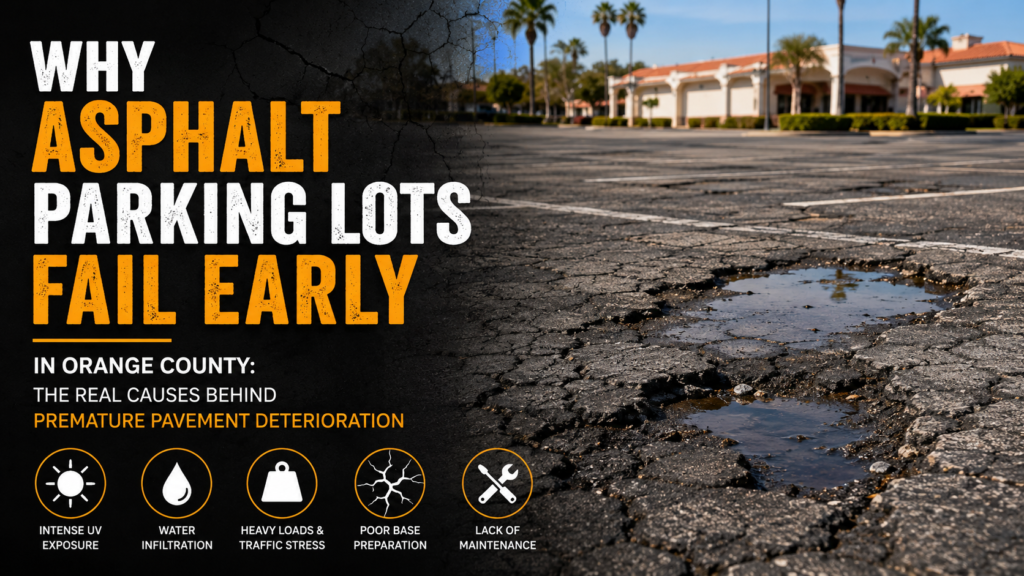
Property owners across Orange County who have invested in Asphalt Parking lots Orange County often find themselves facing cracking, potholes, and surface deterioration far sooner than they expected. A well-designed, professionally installed parking lot should last 20 to 30 years with proper maintenance. Yet many lots in the South Bay, Irvine, Anaheim, and throughout the county show significant distress within five to ten years of installation. Understanding why parking lots fail prematurely and recognizing the specific factors that make Orange County’s environment particularly challenging helps property owners protect their investment and make better decisions when damage appears.
The Fundamental Truth About Asphalt Parking Lot Failure
One of the most costly misconceptions in parking lot management is confusing appearance with performance. A parking lot can look smooth and well-maintained while simultaneously undergoing structural failure that is invisible from the surface. By the time cracks and potholes appear at the surface level, deterioration has typically been occurring for months or years underground. Performance and appearance are not the same thing, and this gap between what a lot looks like and what it is actually doing structurally is at the heart of why so many Orange County properties end up with expensive repair bills that could have been prevented.
Asphalt pavement is designed to flex not to resist. The material absorbs and distributes vehicle loads across the pavement section, transferring them through the aggregate base to the underlying subgrade. When any component of this load-transfer system is compromised whether the surface asphalt is too thin, the base is inadequately compacted, the subgrade is unstable, or water has infiltrated and weakened any layer the entire system begins to fail under the repetitive loading of daily traffic.
Cause #1: Inadequate Base Preparation
The most common cause of early parking lot failure anywhere in the country and Orange County is no exception is inadequate base preparation. The base layer of crushed aggregate beneath the asphalt surface is what actually supports the load. The asphalt is the wearing surface; the base is the structure. When the base is too thin, improperly graded, or insufficiently compacted, the asphalt surface has no adequate support to bear vehicle loads, and it begins to flex, crack, and eventually fail.
Industry standards require that base compaction reach at least 95 percent of maximum dry density before asphalt is placed. When base materials are rushed or inadequately tested during installation, the foundation never achieves the necessary strength. This failure is typically invisible for months or even years the asphalt surface looks fine, but the base is slowly consolidating and moving under traffic. When failure eventually manifests at the surface, property owners are often surprised to learn that the root cause was established on the day of installation.
In Orange County’s development market, where contractors face pressure to complete projects quickly, base preparation is one of the first steps to be compromised. A lot that is paved a day or two too early before the base has had adequate time to be properly wetted, graded, and compacted to specification will fail prematurely even if the asphalt itself is high quality. The visible result is typically rutting in wheel paths, alligator cracking in traffic lanes, and areas of depression that pond water.
Cause #2: Water Infiltration and Drainage Failure
Water is the single most destructive force acting on asphalt pavement in Orange County. This may seem counterintuitive in a region known for its sunshine and relatively low rainfall compared to other parts of the country, but Orange County’s rainfall is highly concentrated into short storm events particularly during El Niño years and even minor infiltration can cause substantial damage over time.
The mechanism is straightforward: water infiltrates existing surface cracks, reaches the aggregate base, saturates and softens it, and the asphalt above loses its structural support. Vehicle loads that the pavement handled easily when dry cause surface deflection and cracking when the base is saturated. In cold weather even Orange County experiences cold nights in January and February infiltrated water can freeze within the pavement structure, expanding and widening existing cracks. Though freeze-thaw is far less severe in Southern California than in colder climates, even minor freeze cycling at parking lot temperature extremes accelerates damage.
Drainage design failures contribute significantly to water damage in Orange County parking lots. Lots that have settled, have inadequate pitch, have clogged catch basin inlets, or have landscape irrigation systems that deposit water onto or under the asphalt surface will accumulate water in ways that accelerate base saturation. The characteristic failure pattern of water-damaged base alligator cracking that forms a network of interconnected cracks resembling reptile skin appears when the base has been so thoroughly softened by moisture that the surface can no longer distribute loads.
Orange County’s mature commercial landscape adds an irrigation-related failure mechanism that is particularly relevant to the region. Many commercial properties have irrigation systems installed adjacent to parking lots, and over years of operation, these systems can direct water beneath the pavement edge, saturating the base in specific zones. The result is localized edge deterioration and failure that follows the irrigation line pattern a damage signature that experienced Orange County paving contractors recognize immediately.
Cause #3: UV Oxidation Orange County’s Silent Binder Killer
Southern California’s UV index ranks among the highest in the continental United States, and this environmental factor makes asphalt performance in Orange County different from most other markets. The UV radiation that makes Orange County sunny and desirable also attacks the asphalt binder the petroleum-based material that binds aggregate particles together and gives asphalt its flexibility and cohesion.
As UV radiation bombards the asphalt surface over months and years, the binder undergoes a chemical process called oxidation. The lighter oils in the binder evaporate and the remaining material becomes progressively harder and more brittle. Oxidized asphalt loses the flexibility that allows it to accommodate minor deflection under vehicle loads and minor dimensional changes from temperature variation. The first visible sign is color change: fresh asphalt is near-black, but oxidized asphalt progressively fades to gray. Many Orange County property owners observe this fading and interpret it as cosmetic it is actually a structural warning.
Once the binder has oxidized significantly, the pavement is subject to two related failure modes. Block cracking rectangular crack patterns that typically appear across the full width of lanes or spaces results from the brittle asphalt’s inability to accommodate thermal expansion and contraction. Longitudinal and transverse cracking follows a similar mechanism. Once these cracks open the surface to water infiltration, the UV-driven surface deterioration triggers the water-infiltration deterioration described above, and the two failure mechanisms compound each other.
The practical implication for Orange County property owners is that sealcoating which forms a protective film over the asphalt surface that resists UV penetration is more important here than in most U.S. markets. A parking lot that might need sealcoating every five years in a less sunny climate may need it every two to three years in Orange County to adequately protect against UV-driven binder oxidation.
Cause #4: Tree Root Intrusion
Orange County’s mature commercial and residential landscape is one of the region’s most distinctive and appealing features. Large shade trees line commercial properties, provide canopy over parking lots, and define the character of established neighborhoods throughout the county. These trees also represent an ongoing and often underestimated source of parking lot damage.
Tree root systems extend horizontally far beyond the canopy drip line in many species, root extension exceeds the canopy radius by a factor of two or three. As these roots grow in diameter over years and decades, they exert sustained upward pressure against any pavement above them. The resulting damage is visible as raised ridges or buckled sections of pavement that follow a linear pattern consistent with nearby tree lines. In parking lots adjacent to mature trees, root heaving creates uneven surfaces that pose trip hazards, complicate ADA accessibility compliance, and eventually produce full panel failures.
What makes root intrusion particularly insidious is that repairs that do not address the root cause literally quickly recur. A pavement section that is repaired without root management will heave again within one to three years as the underlying roots continue their growth. Root barriers installed during repair, selective root pruning in consultation with a certified arborist, or in some cases tree removal (with appropriate City of Orange County approvals for protected species) are the complementary interventions needed to make pavement repairs in root-affected zones durable.
Cause #5: Traffic Loading Mismatches
Many parking lots are designed based on assumptions about the types of vehicles that will use them assumptions that prove incorrect over the facility’s life. A parking lot designed for passenger vehicles may begin receiving delivery trucks, service vehicles, or loaded commercial trucks that far exceed the original design load assumptions. The structural consequences are significant: a fully loaded semi-trailer exerts roughly 10,000 times the structural stress on pavement as a standard passenger sedan.
In Orange County’s active commercial landscape, loading patterns shift as businesses change. A retail center that was built with passenger vehicle assumptions may now serve restaurants with frequent food delivery trucks, a health club with heavy gym equipment deliveries, or a home furnishing store with regular 18-wheeler arrivals. Each of these commercial activities introduces vehicle loading that the pavement was never designed to sustain.
Specific zones within parking lots are particularly vulnerable to concentrated loading: dumpster pads (where refuse trucks make weekly or biweekly stops), loading dock aprons (where trailer legs and landing gear are deployed), and turn radii (where loaded vehicles make tight turns, creating concentrated shear stress in the surface layer). These high-stress zones fail earlier than adjacent parking lanes even when the overall lot is in good condition.
Cause #6: Poor Maintenance Programs and Deferred Repairs
A parking lot’s failure is rarely sudden. It is the accumulated result of small deterioration events that were addressed too late, inadequately, or not at all. Crack sealing is the maintenance intervention with the highest return on investment in parking lot management a small crack sealed promptly for a modest investment can prevent water infiltration that leads to base failure requiring major reconstruction years later. A property manager who defers crack sealing because “it’s just a small crack” is allowing a $200 repair to become a $20,000 reconstruction.
The deferral mindset is understandable: parking lot damage often looks worse than it performs in the short term, and visible cracks don’t always produce immediate consequences that create urgency. But the deterioration occurring underground base saturation, subgrade softening proceeds regardless of whether surface repairs are made, and by the time the consequences become obvious at the surface level, the scope and cost of required repairs has typically multiplied.
Orange County-Specific Considerations for Parking Lot Longevity
Orange County’s commercial real estate market is one of the most valuable in the country. Irvine, Anaheim, Santa Ana, Huntington Beach, and the many other cities that make up the county have high property values and active commercial tenant markets. The condition of a property’s parking lot directly affects tenant satisfaction, customer experience, and property value. ADA accessibility requirements enforced by California’s aggressive disability access compliance framework create liability exposure for parking lots with surface irregularities or inadequate accessible space marking. Any of these business considerations makes well-maintained asphalt not just an operational necessity but a financial and legal priority for Orange County commercial property owners.
Common Questions About Asphalt Parking Lot Failure in Orange County
How can I tell if my Orange County parking lot has base failure? The primary indicator is alligator cracking a pattern of interconnected cracks that resemble reptile skin. Unlike surface cracking from UV oxidation, alligator cracking indicates that the base beneath has been compromised and can no longer adequately support traffic loads. Areas that feel soft or springy underfoot, that have visible depression or rutting, or that have extensive alligator cracking have experienced base failure.
What is the difference between crack sealing and crack filling? Crack sealing uses a flexible rubberized sealant that moves with the crack through temperature cycles, maintaining the seal. Crack filling uses rigid filler material that bridges the crack but does not move. For active cracks in Orange County’s thermal environment where even mild temperature cycles cause asphalt to expand and contract crack sealing with flexible material is the appropriate specification.
How long should a properly installed and maintained Orange County parking lot last? With professional installation, proper drainage design, appropriate maintenance including sealcoating every two to three years and prompt crack repair, an Orange County commercial parking lot should perform for 20 to 25 years. UV exposure and commercial traffic loading make this timeline somewhat shorter than in less sun-intense climates, making proactive maintenance proportionally more important here than in northern markets.